for reliable control and supply voltages in automated systemsIndustrial AutomationIn automated machinery and control cabinets, magnetic components have to absorb load changes, inrush currents, and EMC influences reliably. Kleintges provides robust solutions designed for real process conditions and clear integration into machine architecture.
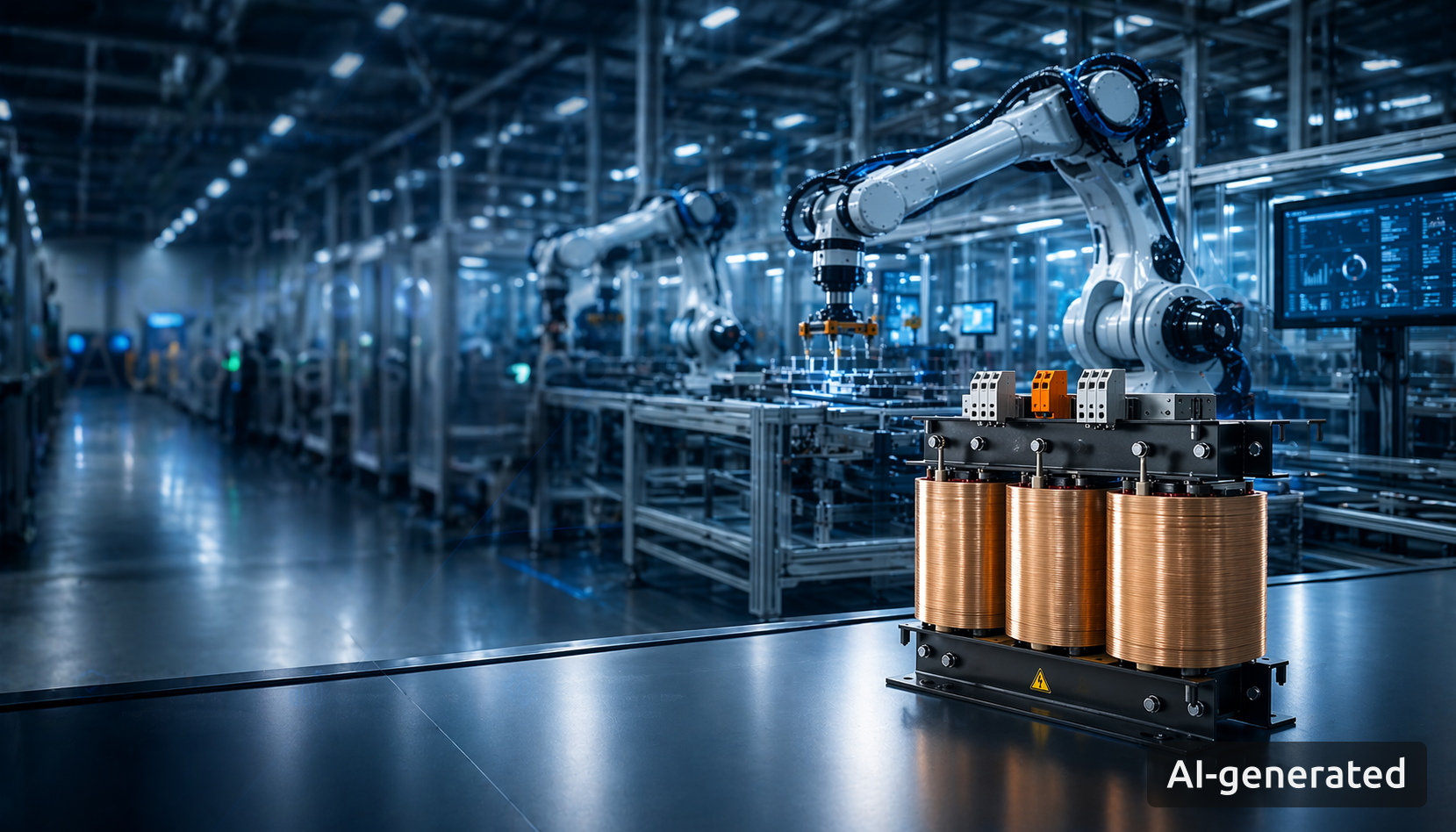
Industrial Automation at a Glance
In industrial automation, transformers, chokes and power supply components must interact reliably with PLCs, sensors, actuators, safety circuits and control cabinets located close to the drives. What is crucial is not merely the provision of a voltage, but how load changes, inrush currents, EMC influences and installation conditions are factored into the actual design.
Several factors are particularly important in this regard:
- stable auxiliary and control voltages for PLCs and control technology
- clean electrical conditions despite the presence of inverters, contactors and switching power supplies
- thermally robust design for continuous operation
- easy integration into control cabinets and machine structures
- reliable performance under dynamic production conditions
Solutions for industrial automation are therefore far more than mere standard components. They form an essential foundation for process stability, plant availability and a traceable electrical architecture.
Why system thinking matters
Particularly in automated systems, transformers and chokes should not be considered in isolation. What is crucial is how they interact with control circuits, drives, power supplies and protection concepts. The load profile, switching behaviour, EMC conditions and mechanical installation requirements have a direct influence on how robust and service-friendly the overall system operates.
In combination with other product groups, reliable power supply solutions can be developed, for example using:
- Control transformers for defined auxiliary and control voltages
- Filter chokes to reduce mains-related and drive-induced interference
- single-phase isolating transformers for sensitive sub-systems and test environments
This results in solutions that are not only electrically clean but also structurally sound and tailored to the specific application.
What matters in automated plants
The value of a well-thought-out design is particularly evident where control and power supply components must operate stably over the long term, even though switching operations, load peaks and EMC influences are a daily occurrence. Generalised standard assumptions are often insufficient here, as even small deviations in the load profile can affect process stability.
The specific benefits are evident in several areas:
- greater process stability during operation
- reduced strain on PLCs and sensor systems
- better management of thermal and electrical load cycling
- cleaner integration into control cabinets and machine modules
- longer service life of the overall system
In industrial automation in particular, it becomes clear just how important precise coordination between control technology and the drive environment is. The chosen solution thus becomes an active component in ensuring system stability.
We are here for youDo you have questions or concerns? We will help you quickly and easily.
Products
Applications
About Us & Careers
Contact
Office Hours:Monday – Friday07:00 AM – 12:00 PM01:00 PM – 04:00 PM
Goods Receiving Hours:Monday – Thursday07:00 AM – 12:00 PM01:00 PM – 04:00 PM Friday07:00 AM – 12:00 PM
Phone Sales:+49 6635 9612 0
Email Sales:sales@kleintges.de
Address:Rabenbornsweg 13, D-36320 Kirtorf
Goods Receiving Hours:Monday – Thursday07:00 AM – 12:00 PM01:00 PM – 04:00 PM Friday07:00 AM – 12:00 PM
Phone Sales:+49 6635 9612 0
Email Sales:sales@kleintges.de
Address:Rabenbornsweg 13, D-36320 Kirtorf
© 1979 - 2026 Kleintges Elektrogerätebau GmbH. All rights reserved.